

News
-
Nutritional care is a human right
Nutritional care is a human right

A new global campaign to promote nutritional care as a universal human right has been launched with support from ESPEN, ASPEN, FELANPE, PENSA and WASPEN, that appointed an international working group for this initiative. A position paper to describe the initiative and its foundation has been jointly published in Clinical Nutrition and Nutrition in Clinical Practice.
Videos are also available on this dedicated Youtube channel.
Article in Press
Clinical nutrition and human rights. An international position paper -
Obesity care: From guidelines to clinical practice
Guidelines galore – new webinar in store! You’re just 1 month away, and we can’t wait to have you on board.

Heard the exciting update? You can now register for our rapidly approaching, dynamic free webinar Obesity care: From guidelines to clinical practice taking place on December 1, 18:30 – 19:30 CET.
This webinar is based on the recently published European guideline on obesity care in patients with gastrointestinal and liver diseases – joint ESPEN/ UEG guideline.
Registration is completely freeand all participants will earn 1 free CME credit just for attending! We look forward to you attending and actively engaging with our experts.
Link to the registration page:
-
PENSA 2021 Joining Hands to improve Quality of Nutrition Support Practices
PENSA 2021 Joining Hands to improve Quality of Nutrition Support Practices

14-16 October 2021, BITEC, Bankong, Thailand
The detail of the program and timeline of the congress can be found on www.pensa2021.com
Email: pensa2021@gmail.com
-
PROMISS (PRevention Of Malnutrition In Senior Subjects in the EU)
PROMISS (PRevention Of Malnutrition In Senior Subjects in the EU)
The challenge of malnutrition
With the European population growing older, the challenge is to keep an increasing number of seniors across all European countries healthy and active.
In Europe, between 13.5 % and 29.7 % of older adults living at home are malnourished or at risk of protein energy malnutrition.
PROMISS aims to better understand and ultimately prevent protein energy malnutrition in seniors. Thereby, PROMISS will contribute to improve active and healthy ageing
PROMISS activities
Within PROMISS, malnutrition is tackled with a specific focus on the prevention of protein-energy malnutrition.
To do so, PROMISS makes use of large scale databases to understand the relationships between food intake, food characteristics, physical activity, the oral and gut microbiota, and poor appetite, malnutrition and poor health among older adults. Preferences and attitudes of older persons with regard to food intake and physical activity are also identified.
Based on the outcomes of this research, PROMISS has developed optimised, sustainable and evidence-based dietary and physical activity strategies, which are now being tested for effectiveness and cost-effectiveness in a long-term intervention study.
The project will show whether these strategies together with new food concepts and products will prevent malnutrition and support active and healthy ageing.
Next steps
The feasibility of increasing protein intake in older persons with a low protein intake, and the potential beneficial effect on relevant clinical outcomes are currently under study in our project.
To disseminate on the final outcomes, PROMISS will also produce:
• a roadmap that outlines the steps, goals, milestones and deliverables for product development.
• a masterclass training course that translates scientific results of PROMISS for the food industry and small and medium enterprises.
A list of continuously updated research highlights can be found here: https://www.promiss-vu.eu/wp-
content/uploads/PROMISS_ Research_findings_highlights_ V201904.pdf.
PROMISS (PRevention Of Malnutrition In Senior Subjects in the EU) is a multi-country project aiming to turn the challenge of tackling malnutrition in community-dwelling older persons into an opportunity for healthy ageing for the future.
The PROMISS consortium contains worldwide expertise in epidemiology, clinical trials, geriatrics, nutrition, physical activity, microbiomics, as well as in behaviour, consumer, sensory and computer sciences. It builds on strong collaborations with food industry and SMEs to strengthen innovation of the European agri-food sector and their market position. Existing data from scientifically well-established prospective aging cohorts and national nutritional surveys from Europe and ‘third countries’ will be combined with new data from short- and long-term intervention studies in older persons at risk. Its holistic approach will provide insight in the causality of the links between diet, physical activity, appetite and malnutrition and underlying pathways, thereby providing the necessary evidence to develop optimal, sustainable and evidence-based dietary and physical activity strategies to prevent malnutrition and enhance active and healthy aging. PROMISS will also deliver food concepts and products as well as persuasive technology to support adherence to these strategies. The dietary and physical activity strategies and food products will be specifically developed with older user involvement to meet the needs and fit the preferences of older consumers. In close collaboration with stakeholders, PROMISS will translate these strategies into practical recommendations to guide policy and health professionals at EU- and Member States level. Dissemination and implementation takes place through strong dissemination partners operating on an European level and linked to national networks across Member States. PROMISS promises prevention of malnutrition, additional healthy life years and a strengthening of EU’s food industry.
Work packages:

PERT diagram showing the overall relationship of work packages of the PROMISS project
First results:
- Older adults with a poor appetite consumed less protein and dietary fiber, less solid foods, smaller portion sizes, less wholegrains, and less fruits and vegetables than older adults with a very good appetite. They consumed more dairy foods, fats, oils, sweets and soda’s. (van der Meij et al. 2017)
- Of those aged 85 years and older, 28% were below the commonly used protein intake target (0.8g of protein per kg of adjusted bodyweight per day). This group ate less meat, more cereals and drank more non-alcoholic beverages than those who had adequate protein intake. (Menonҫa et al. 2017)
- Older adults with a lower protein intake seem to be at greater risk of developing mobility limitations over 6 years. (Houston et al. 2017)
- Low protein intake may negatively affect muscle strength and physical performance in late life, and a combination of adequate protein intake and physical activity may be necessary to reduce the loss of muscle strength in the very old. (Granic et al. 2017)
- Higher protein intake may lower the risk of developing chronic protein-energy malnutrition in community-dwelling older adults. (Hengeveld et al. 2018)
- The Protein Screener 55+ (Pro55+) was developed and validated to screen for low protein intake in community-dwelling older people. An online version is available for researchers and can be found at www.proteinscreener.nl. (Wijnhoven et al. 2018)
- Four different disability trajectories were identified between the ages of 85 and 90: 1) a constant very low disability trajectory (difficulty with none or 1 ADL) over the 5 years; 2) a low disability trajectory (difficulty with 2 ADLs) that steadily progressed to mild disability (5 ADLs); 3) a mild disability score (4 ADLs) at 85 that increased to moderate disability (10 ADLs) by age 90; and 4) a moderate disability score (9 ADLs) that progressed to severe disability (14 ADLs) after 5 years. Those with higher protein intake, especially those at or above 1 g per kg of body weight per day (70g of protein per day for a 70 kg person), were less likely to develop disabilities. (Menonҫa et al. 2018)

25 Partners:
VrijeUniversiteit Amsterdam, Haskoli Islands University Iceland, University of Newcastle Upon Tyne United Kingdom, National Institute for public health and the environment The Netherlands, SyddanskUniversitet Denmark, GoeteborgsUniversitet Sweden, Netherlands Organization for Applied Scientific Research the Netherlands, VIVES University College Belgium, Ghent University Belgium, HAS University of Applied Sciences the Netherlands, Kellogg Management Services United Kingdom, Laboratoires Grand Fontaine Spain, Fonterra the Netherlands, Blonk Consultants the Netherlands, Frigilunch Belgium, Henri BV Belgium, University of Helsinki Finland, The European Federation of the Association of Dieticians the Netherlands, European Society for Clinical Nutrition and Metabolism Luxemburg, European Geriatric Medicine Society Belgium, Friedrich-Alexander-Universitaet Erlangen Nuernberg Germany, AGE platform Europe AISBL Belgium, Université de Sherbrooke Canada, Amsterdam AMC – location VU University Medical Center, HAN University of Applied Sciences the Netherlands.
Contact & information:
Please visit our website: http://www.PROMISS-vu.eu/
Twitter: @PROMISS_VU
Facebook: www.facebook.com/promissproject/
Email: PROMISS.po@vu.nl
-
Salford ESPEN - Intestinal Failure Workshop - Webinar
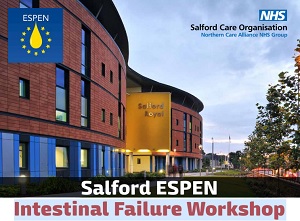 Salford ESPEN
Intestinal Failure WorkshopThe annual Salford ESPEN-endorsed Workshop on Acute and Chronic Intestinal Failure will be held as a webinar on 23rd & 24th April 2021
The course will be virtual in nature and aimed at physicians, surgeons, dietitians, pharmacists, nurses and psychologists with an interest in Intestinal Failure.
Delegates will gain experience in how a dedicated Intestinal Failure Unit functions and the role of the multidisciplinary team.
Places are limited due the interactive nature of the programme.
Preference is given to ESPEN members.
Previous courses have been very well received, particularly the practical demonstrations of central venous catheter care and management, surgical-medical interaction, case-based discussions and patient-centred ward rounds.Numbers are limited to 40 delegates and ESPEN members have priority.
COST: 120 Euros. To apply for a place, please send a CV to:
Angela Page angela.page@srft.nhs.uk or contact: +44 161 206 5364
or Professor Simon Lal, Course Director simon.lal@srft.nhs.uk -
The importance of clinical nutrition by former ESPEN President Prof. André Van Gossum
The importance of clinical nutrition by former ESPEN President Prof. André Van Gossum

NutritionInsight spoke with Professor André Van Gossum, M.D, European Society for Clinical Nutrition and Metabolism (ESPEN) Chairman at the 40th ESPEN Congress in Madrid, Spain, about the growing importance of nutritional therapies for clinical patients.
-
UEG public affairs report and action plan on nutrition
UEG public affairs report and action plan on nutrition
View report here (PDF document)
-
UEG Summer School

Application for the UEG Summer School will be open from February 1 – 28, 2023.
UEG Summer School
June 9 – 10, 2023
Prague, Czech Republic
- For clinicians (medical, surgical or imaging hepato-gastroenterologists) in their first to fourth year of training at the time of application
- up to 40 years of age, possible exceptions for main carers of children
We offer two types of registrations fees (€ 200 / € 100) to broaden accessibility, please find the country list attached.
What to expect?
This top quality, interactive and intense course is dedicated to hands-on training on various topics with renowned experts in small groups, while faculty and applicants will have opportunities to meet, socialise and share ideas in the evenings. Please go to UEG Website to find the detailed programme, designed by our course directors Roberto Penagini (Italy), Minneke Coenraad (NL), and Ignacio Catalan (Norway).
-
UEG Week
UEG Week
UEG Week in Copenhagen feels to be around the corner and we are very pleased to announce this event which will be held from October 14-17, 2023. UEG Week is the annual event where the whole GI community comes together, meets & networks and picks up on the latest science and education. Scientific program is available here.

-
UEG Week Virtual 2021: October 3 – 5

UEG Week Virtual 2021: October 3 – 5
In 2017, ESPEN was officially accepted as an affiliated member society of UEG (United European Gastroenterology).
UEG unites all the leading European medical specialists and national societies focusing on digestive health and related disciplines representing their specialty on a pan-European level, meaning a community of over 50'000 digestive health specialists.
As an UEG member society, ESPEN will be present at the UEG Week Virtual 2021 in the Societies Member Village and we invite you to check the programme of the meeting featured across many virtual lecture halls, covering all fields of Gastroenterology, as well as Nutrition concerns. -
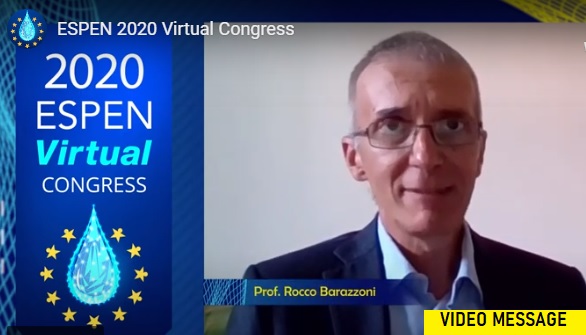
Video Message from Rocco Barazzoni, ESPEN Chairman
Video Message from Rocco Barazzoni, ESPEN Chairman
-
VIRTUAL ESPEN WORKSHOP NUTRITION in IBD patients
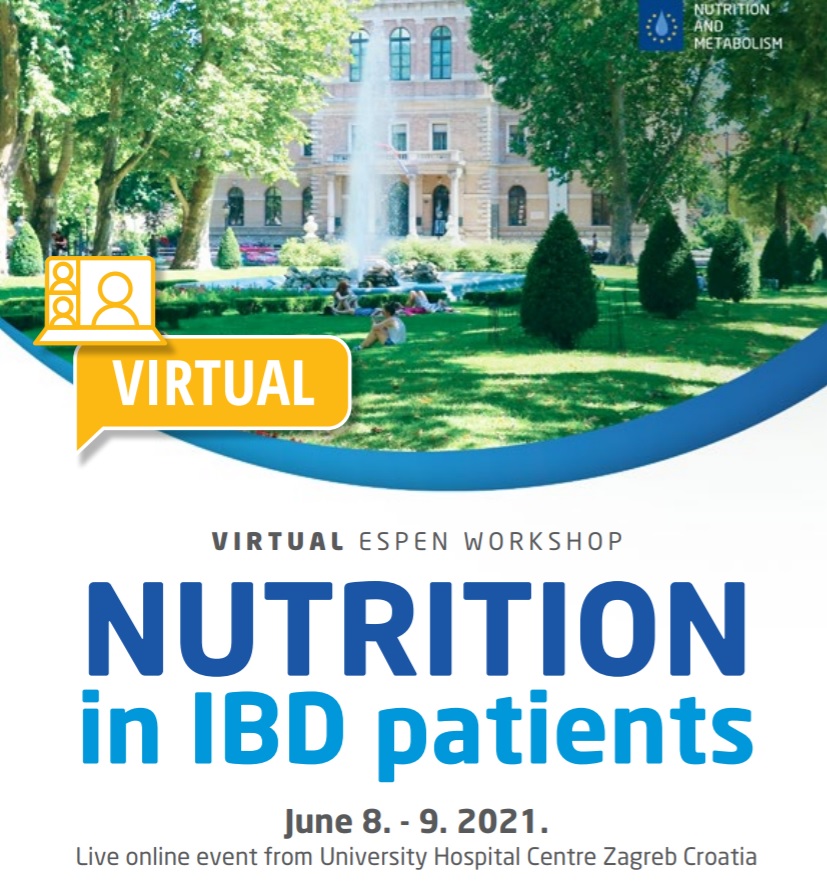
VIRTUAL ESPEN WORKSHOP NUTRITION in IBD patients
June 8. - 9. 2021. Live online event from University Hospital Centre Zagreb Croatia
ORGANISING COMMITTEE
• Prof. Željko Krznarić, MD, PhD
• Ana Barišić, MD
• Prof. Darija Vranešić Bender, BSc, PhD
• Irena Karas, mag.nutr.
• Dina Ljubas Kelečić, M Pharm
• Andreja Horvat, nurseVENUE
Online platform: streaming from University Hospital Centre Zagreb, Department of Internal Medicine, Unit of Clinical Nutrition & Department of Gastroenterology, Kišpatićeva 12, 10 000 Zagreb, Croatia / Educational Center & Clinic
APPLICATION
We can accept (only) 100 applicants for this workshop.
Registration will take place on a first come first served basis. Priority will be given to ESPEN members. In your application, please indicate whether you are a member or not. Please also provide a short overview of your background and motivation to follow this workshop. We look forward to receive your application.
Registration deadline is: June 1st 2021. Please, register at: https://espen.digitalnasoba.com